- cross-posted to:
- science@beehaw.org
- cross-posted to:
- science@beehaw.org
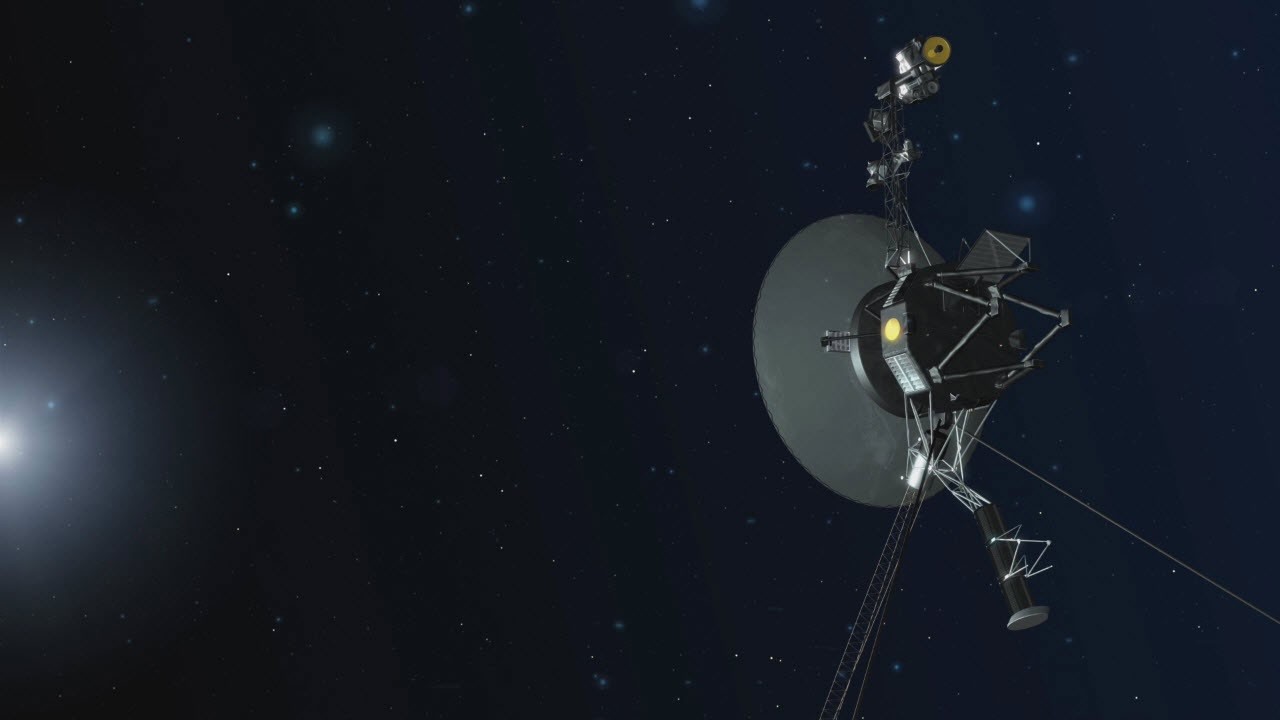
Voyager 1 at 1 light-day away, countdown here.
I suppose that this is in the sense of radar-distance. Then does anyone here know if the countdown is for the event of the outgoing-signal departure from Earth, or for the event of the return-signal arrival to Earth, or for the mid-point? Since these are all 24h apart! 😂
Or is this geodesic proper distance, measured in the barycentric coordinate time TBC?
You must log in or register to comment.
V’Ger from the delta quadrant.
Fun fact voyager’s radio signal broadcasts at about 5W… about the same power as a wrist watch.
Space is incredibly noisy and that 5W signal gets drowned out. The way we hear it is with two sets of dish arrays. One pointed at voyager, and one pointed just slightly off and subtract the one off from the main. That’s step 1.
V’ger 1 went silent for 2 days this mid-October. One site said it’s signal-strength on Earth is now about 1 attowatt (a billionth of a billionth of a watt). “The largest dish at each site measures about 230 feet (70 meters) across.” Won’t last much longer.
https://www.earth.com/space/voyager-1-one-light-day-silent-two-days-october-2026/
We should have been launching a Voyager mission every decade to send the best available solar panels at the time.
Voyager doesn’t run off solar panels, it’s way too far from the sun for those to work and has been for decades. It uses heat from nuclear fuel.
Two things.
-
Solar Panels are useless at the distance the Voyager probes are from Earth. The sun is a bright star at that distance. You don’t send solar panel equipped craft on these missions. You send RTG equipped craft instead, which sets a time limit.
-
What trimmed down Voyager from the proposed Grand Tour plan from the 1960s was the same thing that limited Voyager launches in the 80s and 90s – money. There was a Voyager-like mission launched in the 2000s. New Horizons. It famously visited Pluto in 2013, but like Voyager, it also visited Jupiter and did science there. And like Voyagers 1 and 2, it’s on its way out of the solar system.
I’m sure scrounging up enough Plutonium for almost 500W of power is also an issue. That’s how much power Voyager generated at launch, from three P-238 RTGs. New Horizons got only one, and only generates roughly 240W. When they launched that, there was a whole thing about whether or not a launch failure would cause contamination. That too is likely an answer why we don’t send one out every 10 years.
-
49 years of traveling means 49*365 =17885 days, so an error of 1 day is a relative error of 1/17885 or 0.006%. In one word, irrelevant.
You are confusing time and distance. Light day is a distance that light can travel in one day. It is not a measure of time.
It did the calculation in days because the math is more obvious. I guess I was wrong asumming that everyone will understand the equivalence. Just multiply by the (average) velocity of the Voyager and you have the distance travelled and you will arrive at the same 0.006% of relative error. So the point is that all the different distances described by the OP are essentially the same from an empirical point of view, even when they are calculated using events that are 24h appart.
I see. So if I get you right, you mean that passing the threshold of one light day on a spacific day is uninteresting, because Voyager was relatively very close the day before or after? If that’s what you mean, you are right, the distance is not very interesting. But we’re not dealing with an interesting distance threshold, we’re dealing with a psychological threshold. It’s interesting to people and it’s a great excuse to bring public attention to science and space exploration.
So if I get you right, you mean that passing the threshold of one light day on a spacific day is uninteresting, because Voyager was relatively very close the day before or after?
Yeah, we are talking of astronomical distances and the speed of the Voyager is relatively too slow to make a significant difference in the distance traveled in just one day, it’s well within any measurement error.
It’s interesting to people and it’s a great excuse to bring public attention to science and space exploration.
Of course, but that’s not what this post is about.
A day here, a day there, and next thing you know you’ve missed the moon and your manned mission is headed off into deep space.